

National Curriculum (England) · Year 1
Year 1 Common Exception Words
The 45 tricky words from the National Curriculum, read aloud in a free game, with flash cards to print.
Year 1 (ages 5–6, Key Stage 1) is roughly kindergarten in the US. The game is in English: every word is read aloud, so children hear it as they find it.
41 of the 45 are also on the American Dolch sight word lists; tap one to see its own page with sentences and a game.
What are common exception words?
Common exception words are everyday words whose spelling doesn't match the phonics a child has learnt so far. Said has an ai that sounds like e; one sounds nothing like it looks. Children can't sound them out yet, so they learn to recognise them by sight. Many phonics programmes call them tricky words or red words.
England's National Curriculum lists 45 for Year 1. It also says schools may use others from their own phonics programme, so the list your child brings home might differ by a few words.
In June of Year 1, children take the phonics screening check: they read 40 words aloud to their teacher, some real and some made-up. Common exception words aren't on it, because the check tests sounding out. They matter for everything else: these 45 words turn up on almost every page of a first reading book.
Play them in groups
5 groups. Each link opens the mini games using only those words. Missing Word needs a sentence for every word, so it sits out groups with words that have none. Every word is read aloud in our recorded voice.
| Group | Words | |
|---|---|---|
| 1 | the, a, do, to, today, of, said, says, are | Play group 1 |
| 2 | were, was, is, his, has, I, you, your, they | Play group 2 |
| 3 | be, he, me, she, we, no, go, so, by | Play group 3 |
| 4 | my, here, there, where, love, come, some, one, once | Play group 4 |
| 5 | ask, friend, school, put, push, pull, full, house, our | Play group 5 |
Play group 1 now
Your child hears a word and finds it: pulling the right carrot, hopping to the right lily pad, posting the right letter.
Year 1 · group 1
Free to play · no signup · works on phones, tablets and computers
How to teach them
Most of these words are only odd in one place. In said it's the ai; in was it's the a. Point to that part, say what it does, and the rest can be sounded out as normal.
Pick five words, read them on cards for two minutes, and stop. Add a new word when the old ones come instantly.
Ask your child to find the or said on a page of their reading book. Finding a word in a real story is what makes it stick.
Printable flash cards
Checklist: which words are secure?
Download the checklist as a PDF
The same checklist as a one-page file, ready to print or send home: all 45 words, with three boxes for three check-ins.
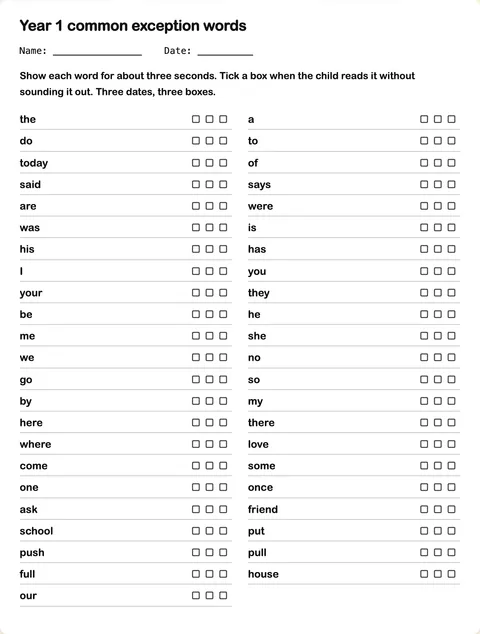 Year 1 common exception words checklist
Questions
Are these the official words?
Yes, copied exactly from the Department for Education's spelling appendix to the National Curriculum. Schools may use a slightly different list from their phonics programme.
Are common exception words the same as sight words?
Close. Sight words is the American term for words children learn to read on sight, often from the Dolch or Fry lists. Common exception words are England's list, chosen because their spelling breaks the phonics rules taught so far.
What US grade is Year 1?
Year 1 (ages 5–6, Key Stage 1) is roughly kindergarten in the US. UK children start school a year younger, so they meet these words at about the same age as American children meet the Dolch pre-primer and primer lists.
Is the spelling British?
These words are spelt the same in British and American English, so nothing changes. Spelling practice for the same lists is on our sister site, Spellcove.
Our school uses Little Wandle (or Read Write Inc.) and sends tricky words home each week. Can we practise those?
Yes. Phonics programmes teach tricky words in their own order, phase by phase; Little Wandle calls them tricky words and Read Write Inc. calls them red words. Type or paste this week's words into the list maker and the whole game plays with just those words. Bookmark the link and change the words each week.
My Reception child has the Year 1 phonics screening check next year. Should we practise tricky words?
Practise them for reading, but they aren't what the check tests. The check, taken in June of Year 1, is 40 words that children sound out and blend, and some are made-up words, so it measures decoding. The best preparation is the sounds your child is learning in class, and blending them into words, a few minutes a day. Tricky words still matter for reading real books.
We speak Arabic at home and my child is at a British school. How can I help with English tricky words?
Read the words aloud together every day, because hearing them matters as much as seeing them. Every word in the game is spoken in English in a recorded voice, so your child hears it each time they find it. Point out the tricky part of each word (said has ai making a short e), and read short English books together. Our Arabic guide for parents explains this in Arabic.
Is it free?
Yes. The whole game plays free in the browser, with no sign-up and no adverts, and the sheets print as often as you like.

An app is on the way
We're building a Wordburrow app for iPhone. The plan is everything you can play here, plus offline play and a parent view of the words that have stuck. It isn't out yet. The whole game is free here in the meantime.
Coming soon on theApp Store