
National Curriculum (England) · Year 2
Year 2 Common Exception Words
The 64 Year 2 tricky words, read aloud in a free game, with flash cards and a checklist to print.
Year 2 (ages 6–7, Key Stage 1) is roughly 1st grade in the US. The game is in English: every word is read aloud, so children hear it as they find it.
The 64 Year 2 common exception words
- door
- floor
- poor
- because
- find
- kind
- mind
- behind
- child
- children
- wild
- climb
- most
- only
- both
- old
- cold
- gold
- hold
- told
- every
- everybody
- even
- great
- break
- steak
- pretty
- beautiful
- after
- fast
- last
- past
- father
- class
- grass
- pass
- plant
- path
- bath
- hour
- move
- prove
- improve
- sure
- sugar
- eye
- could
- should
- would
- who
- whole
- any
- many
- clothes
- busy
- people
- water
- again
- half
- money
- Mr
- Mrs
- parents
- Christmas
27 of the 64 are also on the American Dolch sight word lists; tap one to see its own page with sentences and a game. Mr and Mrs are on the flash cards but not in the game, which would show them without their capital.
What are common exception words?
The Year 2 list is longer and harder: because, beautiful, people, busy. Children are expected to read these and, by the end of Year 2, to spell most of them too. As in Year 1, the curriculum lets schools add or swap words from their own phonics programme.
Some words, like fast, last, path and bath, are only exceptions in accents where the a sounds like the a in father. In the north of England, where it sounds like cat, they're perfectly regular.
A lot of the list comes in families: find, kind, mind, behind; old, cold, gold, hold, told; could, should, would. Teaching a family together is far quicker than five separate words.
Play them in groups
6 groups. Each link opens the mini games using only those words. Missing Word needs a sentence for every word, so it sits out groups with words that have none. Every word is read aloud in our recorded voice.
| Group | Words | |
|---|---|---|
| 1 | door, floor, poor, because, find, kind, mind, behind, child, children, wild | Play group 1 |
| 2 | climb, most, only, both, old, cold, gold, hold, told, every, everybody | Play group 2 |
| 3 | even, great, break, steak, pretty, beautiful, after, fast, last, past | Play group 3 |
| 4 | father, class, grass, pass, plant, path, bath, hour, move, prove | Play group 4 |
| 5 | improve, sure, sugar, eye, could, should, would, who, whole, any | Play group 5 |
| 6 | many, clothes, busy, people, water, again, half, money, parents, Christmas | Play group 6 |
Play group 1 now
Your child hears a word and finds it: pulling the right carrot, hopping to the right lily pad, posting the right letter.
Year 2 · group 1
Free to play · no signup · works on phones, tablets and computers
How to teach them
Learn could and then show should and would: same ould, one new letter. The same works for ind and old words.
These are the only common words where ea sounds like the a in make. Learn them as a set of three.
Once a word is read instantly, ask for it on a whiteboard. Year 2 is when reading these words turns into spelling them.
Printable flash cards
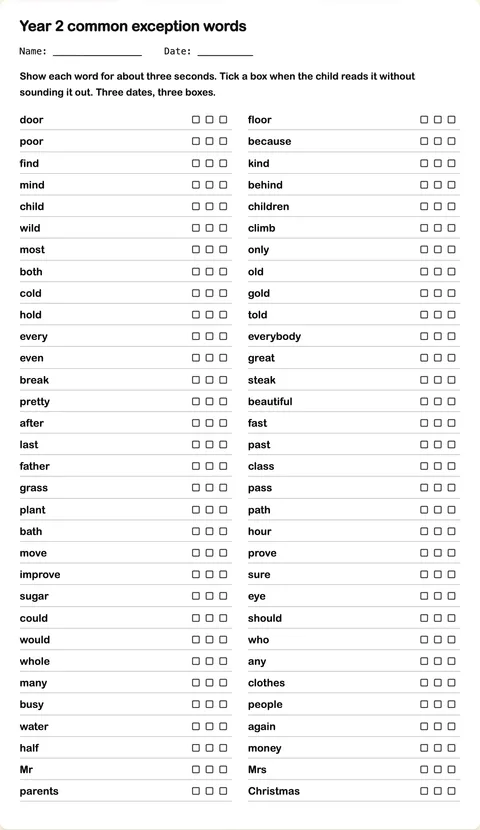
Checklist: which words are secure?
Download the checklist as a PDF
The same checklist as a one-page file, ready to print or send home: all 64 words, with three boxes for three check-ins.
 Year 2 common exception words checklist
Questions
Are these the official words?
Yes, copied exactly from the Department for Education's spelling appendix to the National Curriculum. Schools may use a slightly different list from their phonics programme.
Are common exception words the same as sight words?
Close. Sight words is the American term for words children learn to read on sight, often from the Dolch or Fry lists. Common exception words are England's list, chosen because their spelling breaks the phonics rules taught so far.
What US grade is Year 2?
Year 2 (ages 6–7, Key Stage 1) is roughly 1st grade in the US. UK children start school a year younger, so they meet these words at about the same age as American children meet the Dolch first and second grade lists.
Is the spelling British?
These words are spelt the same in British and American English, so nothing changes. Spelling practice for the same lists is on our sister site, Spellcove.
Our school uses Little Wandle (or Read Write Inc.) and sends tricky words home each week. Can we practise those?
Yes. Phonics programmes teach tricky words in their own order, phase by phase; Little Wandle calls them tricky words and Read Write Inc. calls them red words. Type or paste this week's words into the list maker and the whole game plays with just those words. Bookmark the link and change the words each week.
We speak Arabic at home and my child is at a British school. How can I help with English tricky words?
Read the words aloud together every day, because hearing them matters as much as seeing them. Every word in the game is spoken in English in a recorded voice, so your child hears it each time they find it. Point out the tricky part of each word (said has ai making a short e), and read short English books together. Our Arabic guide for parents explains this in Arabic.
Is it free?
Yes. The whole game plays free in the browser, with no sign-up and no adverts, and the sheets print as often as you like.
An app is on the way
We're building a Wordburrow app for iPhone. The plan is everything you can play here, plus offline play and a parent view of the words that have stuck. It isn't out yet. The whole game is free here in the meantime.
Coming soon on theApp Store